
Quarterly insights: Process technology
Drug discovery “rocket scientist” team expands

In our last Process Technology Quarterly Insights, we profiled what we termed the drug discovery rocket scientists: companies using unique model systems, data analysis and advanced algorithms to discover and advance drug candidates. This quarter we highlight a new entrant to the space, Vyant Bio (VYNT), formed from the merger of Cancer Genetics and StemoniX.
Vyant is an interesting combination of Cancer Genetics’ vivoPharm business, which focuses on preclinical and clinical drug development and testing, and StemoniX’s class-leading human organoid and computational prowess. The resulting human-biology-first, integrated biological, computational, and experimental technology platform appears to have the potential to make significant contributions to drug development, especially in human-centric diseases that have no adequate animal or in vitro models.
Prior to the merger, privately held StemoniX was primarily a drug discovery technology provider (providing assays or service), while publicly traded Cancer Genetics was a preclinical analytical and regulatory service provider on a fee-for-service basis. As Vyant, they will focus on integrated drug discovery, developing proprietary drug leads and preclinical and clinical leads within biopharma-funded partnerships that provide Vyant economic interests in the drugs it enables.
While the rest of the profiled “rocket scientist” group – Schrodinger (SDGR), BioXcel (BTAI), SimulationsPlus (SLP), Viva Biotech (1873.HK), and Codexis (CDXS) – entered a lower orbit during the quarter as their stock prices generally declined, we continue to believe this sector has the potential to fundamentally transform human health just as rocket science fundamentally transformed our economy and society.
TABLE OF CONTENTS
Includes discussion of six private companies
- Merger completed in March
- Team
- Technology
- Customer relationships
- Rocket-science potential
- Process technology index declined and recovered in Q1
- After three sluggish quarters, process technology M&A activity rebounds
- Q1 private placements continue to accelerate
Merger completed in March
The definitive merger agreement that created Vyant, announced in August 2020, was structured as a reverse merger with conditions that included a requirement to raise $10 million for the combined entity. On Jan. 28, Cancer Genetics announced a $10 million private placement at $3.625 per share, with the proceeds to be available to the combined company when the merger closed. On Feb. 10, Cancer Genetics announced a $17.5 million registered direct offering at $6.30 per share.
Following the required shareholder approval, announced March 25, the merged company began trading under the ticker VYNT on March 31. We look at three factors as being key to Vyant’s ability to realize its potential: team, technology and customer relationships.
TABLE 1: Drug discovery “rocket scientist” companies’ financial profile
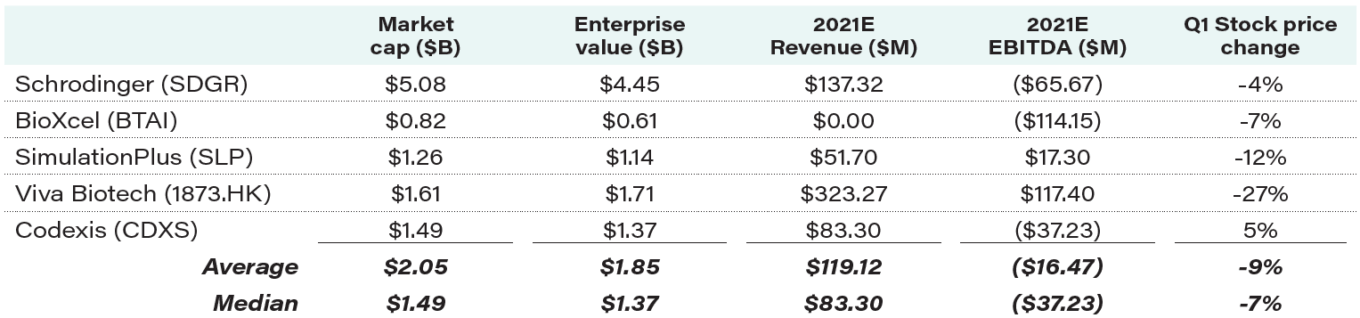
Source: Capital IQ, as of April 20, 2021.
Team
Having a strong senior management team is particularly critical for Vyant given the challenges of forging an integrated company from two organizations at very different stages of development and with different business models. Based on our interactions with members of the senior teams on both sides, Vyant appears to be in good stead on this front, with a combined team that brings a mix of technology expertise, public and private company management experience, and large and small company perspective that is unusual for a company of this size.
Technology
StemoniX’s main contribution to the merged company was market-leading technology. Its biological platform is based on human induced pluripotent stem cells (iPSCs). Pluripotent stem cells are so-called master cells, able to make cells from all three basic body layers, so they can potentially produce any cell or tissue the body needs to repair itself.
StemoniX’s technology uses adult human cells to generate pluripotent stem cells and mature them into other specific types of adult cells. It then uses these iPSCs to generate organoids (multicellular clusters, or micro-organs) that can exhibit certain characteristics and functions of human tissue, for example neural signaling or muscle contraction.
Finally, StemoniX’s technology includes a detection and software system that can be used to interrogate the micro-organs after they’ve been exposed to a drug candidate. This combination enables high-throughput screening of drug candidates for efficacy and safety in a human-biology-first model. This not only reduces the use of animal models in early-stage discovery but also improves drug development cost efficiency and timelines.
Further, while there are a number of animal models and cell-based assays that work well for assessing drug candidates’ impact related to diseases affecting certain organs and human systems, conditions in other areas, such as central nervous system diseases, have few predictive models and are ripe for micro-organ approaches.
Customer relationships
On the other side of the merger, Cancer Genetics’ vivoPharm business contributed 1) years of experience working for pharma on preclinical testing and regulatory requirements for investigational new drug filings and 2) tested and audited global infrastructure that Vyant can use to execute discovery programs for biopharma partners or for its own drug development pipeline. This effectively provides a nice execution arm to help deliver StemoniX technologies on a commercial and validated basis.
Rocket-science potential
So what will we look for in assessing Vyant’s progress? Vyant needs to continue to execute successfully with and build on its legacy customer base. Its technology needs to lead to substantial and impactful research papers and results. Most importantly, it needs to sign funded royalty and milestone deals with biopharma.
Biopharma doesn’t enter into such agreements lightly, so even small deals will be a strong indicator of Vyant’s value proposition to a partner. While such deals can take a long time to get completed, the $27 million in capital Vyant raised should provide adequate resources and runway to get initial deals signed if its technology and capabilities are as compelling as they appear to be.
With success, we believe Vyant can join the ranks of drug development “rocket scientists” in fundamentally transforming human health management just as traditional rocket scientists fundamentally transformed our economy and society with developments in aerospace.
Request full report
To access the full report, please provide your contact information in the form below. Thank you for your interest in First Analysis research.